
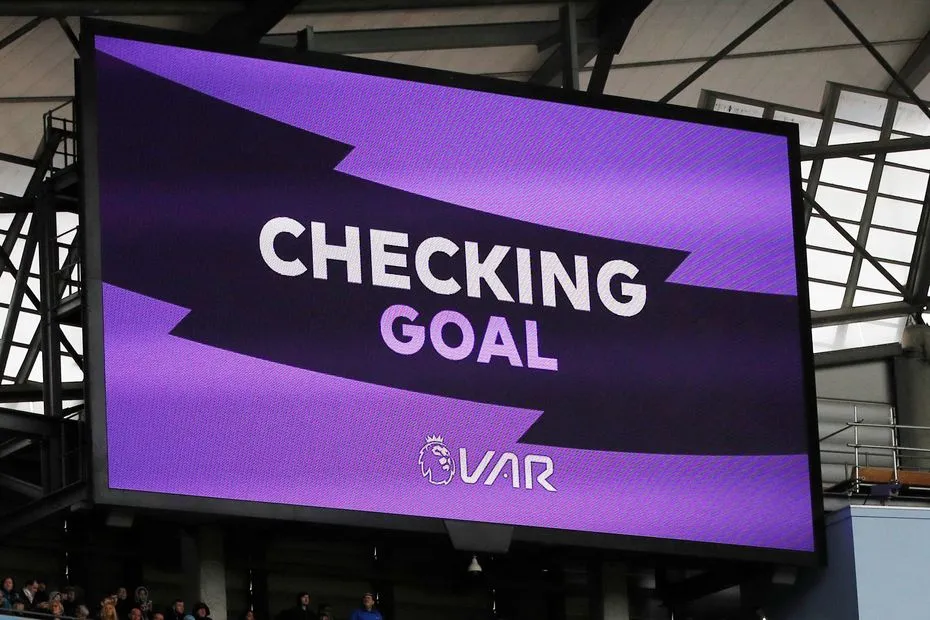
VAR was introduced to reduce controversy.
Instead, it may have created a version of football where controversy has become permanent.
Every weekend now feels less about the football itself and more about the process of validating it. Goals are no longer moments. They are investigations. Celebrations are delayed by uncertainty.
Managers spend more time discussing interpretations than tactics. Supporters leave stadiums arguing about freeze frames instead of performances.
And the deeper issue is this:
VAR is no longer just influencing results. It is reshaping how football is emotionally experienced.
The recent controversy surrounding West Ham’s disallowed equaliser against Arsenal highlighted the core problem. The debate was not simply whether the decision was right or wrong.
The debate became whether similar incidents had previously been ignored, whether Arsenal had benefited from inconsistent interpretations all season and whether referees themselves truly understand the thresholds they are applying.
That is where football’s relationship with technology has fundamentally changed.
The issue is no longer accuracy.
The issue is trust.
According to the Premier League’s Key Match Incidents panel, VAR errors have risen significantly this season, reigniting criticism around consistency and accountability.
You can review the IFAB Laws of the Game here:
https://www.theifab.com/laws/latest/
You can also follow the Premier League’s officiating updates here:
https://www.premierleague.com/news
The Psychological Cost of VAR
Football was built on emotional immediacy.
A goal triggered chaos instantly. Players celebrated. Fans erupted. Momentum shifted in seconds.
VAR interrupts that emotional chain.
Now every major moment carries an invisible asterisk:
- Was somebody offside?
- Was there a foul in the buildup?
- Did the ball brush a hand?
- Was contact sufficient?
- Will the referee be sent to the monitor?
The result is a sport increasingly trapped between reaction and verification.
The problem is not technology itself. Other sports use replay systems successfully. The problem is football’s fluidity. Football was never designed to be dissected frame by frame because the game itself contains constant physical interaction and subjective interpretation.
That subjectivity is where VAR struggles most.
Why Consistency Is Impossible
The biggest misconception around VAR is the idea that technology removes subjectivity.
It does not.
Technology only magnifies subjective moments.
Handball interpretations continue to shift. Contact thresholds vary weekly. The same type of challenge can lead to three different outcomes depending on referee interpretation, VAR intervention and camera angle availability.
This became especially visible in both the Premier League and Scottish Premiership title races recently.
In Scotland, Hearts supporters were left furious after Celtic received a late penalty against Motherwell following a lengthy VAR review involving Auston Trusty. The fallout dominated Scottish football discussion for days because supporters no longer argue purely about decisions — they argue about process credibility.
The Scottish FA’s officiating updates can be found here:
https://www.scottishfa.co.uk/referees/
That distinction matters.
Football supporters historically accepted referee mistakes because they were human errors made in real time.
VAR changes the expectation. If technology exists, supporters expect perfection. Anything less becomes evidence of incompetence, bias or systemic failure.
That is an impossible standard.
Referees Are Becoming More Passive
Another unintended consequence is referee behaviour itself.
Officials increasingly appear reluctant to make definitive decisions immediately because VAR exists behind them. This creates slower decision-making, uncertainty and overreliance on secondary review systems.
The Aston Villa vs Newcastle FA Cup tie earlier this season — played without VAR — exposed the reverse side of the issue. Referee mistakes were immediate, visible and heavily criticised because there was no safety net available.
So football now exists in an uncomfortable middle ground:
- Without VAR, errors feel unacceptable.
- With VAR, delays and inconsistencies feel unbearable.
There may no longer be a version of officiating that satisfies everyone.
The Bigger Problem: Football’s Identity
The real danger is not incorrect decisions.
The real danger is that football becomes defined by officiating discourse.
Look at modern football coverage:
- Match analysis increasingly focuses on refereeing
- Social media discourse revolves around decisions
- Managers strategically discuss officiating pressure
- Clubs release statements about VAR
- PGMOL audio releases become headline content
The game itself is slowly becoming secondary.
That shift damages football’s emotional simplicity — the very thing that made it globally dominant in the first place.
Could VAR Eventually Be Scaled Back?
Completely removing VAR now feels unlikely.
Too much infrastructure, money and institutional investment exists for football authorities to reverse course entirely.
Instead, the more realistic outcome is simplification.
Potential future adjustments could include:
- Limiting VAR intervention scope
- Time restrictions on reviews
- Greater referee autonomy
- Semi-automated offside expansion
- Live referee explanations inside stadiums
FIFA has already trialled enhanced communication systems at major tournaments:
https://www.fifa.com/
UEFA continues refining semi-automated offside technology in European competition:
https://www.uefa.com/
But even if systems improve technically, football may never fully recover the spontaneity VAR disrupted.
That emotional trade-off is permanent.
Final Thoughts
VAR was supposed to remove football’s biggest injustices.
Instead, it may have exposed something far more uncomfortable:
Football is too subjective, too emotional and too chaotic to ever be fully controlled by technology.
The sport’s beauty has always lived in imperfection.
The more football tries to eliminate that imperfection, the more it risks losing part of itself in the process.
If you want the intelligence brief, subscribe here.
This is where the noise gets filtered out.
Related reading on Real Football Man:
https://realfootballman.com/why-the-premier-league-is-dominating-european-football-and-what-it-means-for-the-rest-of-europe/